 WasteOpsWasteOps
A disputed fine. A missed-collection claim raised weeks later. A service review with no real evidence behind it. WasteOps exists because collection software has historically answered those with a reconstructed guess — a report assembled after the fact from whatever a crew can still remember. WasteOps answers differently: a missed bin, an access issue, contamination — anything abnormal — is written the instant it happens, timestamped and photographed, on or offline, and never silently overwritten. A routine collection isn't logged on its own; when a round closes with no exception against a property, that property is treated as collected. Corrections don't erase history — they're added as new records on top of it.
Household waste management is available now — built and demonstrable today. Street cleansing and ad-hoc highway response are newer modules, still in development.
WasteOps hasn't been deployed with a customer yet — what you'd be looking at is a real, working build. Get in touch and we'll walk you through exactly where things stand.
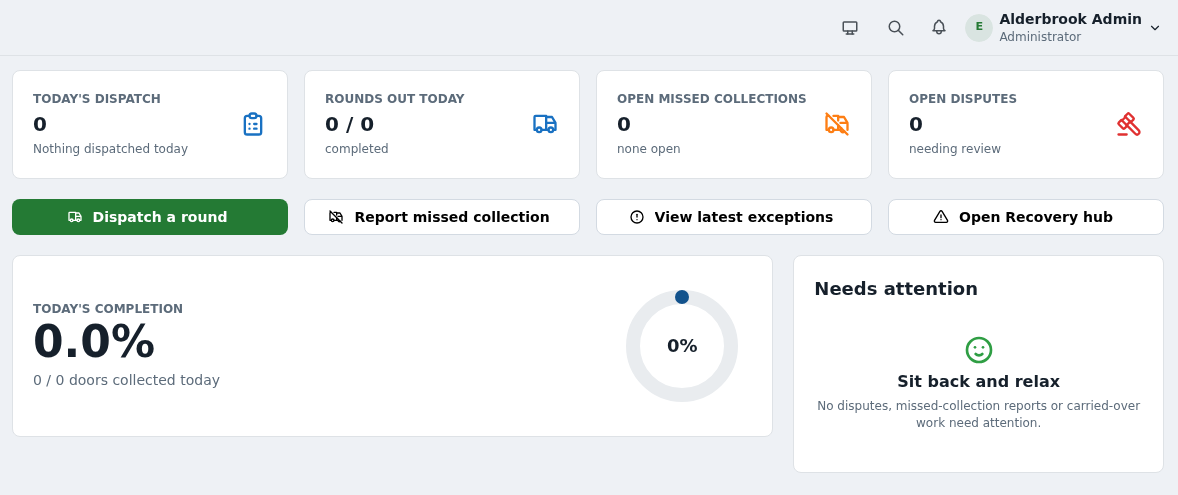
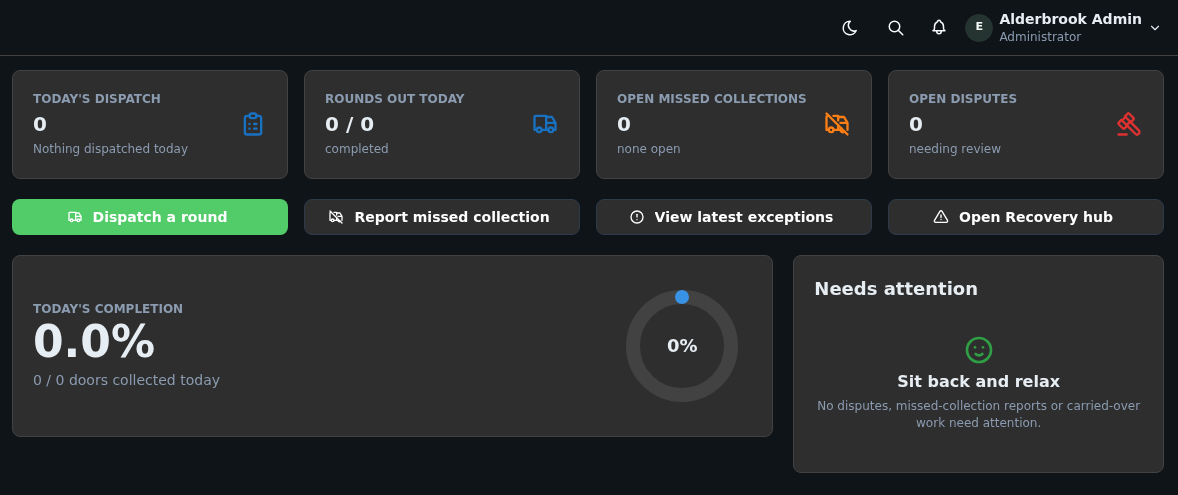
Tuesday, 6:40am. A crew's tablet dies halfway down a road, no signal to begin with. Three weeks later a resident disputes a missed bin on that same street. The supervisor needs to show exactly what happened and when — not reconstruct it from a driver's memory.
Four connected products answer that, below — because the record that supervisor needs isn't one clever feature, it's the office, the crew, the resident, and the fleet all reading and writing the same thing.
Office, Crew, Resident, and FleetCheck are built today. Council-CRM connectivity runs underneath all of them.
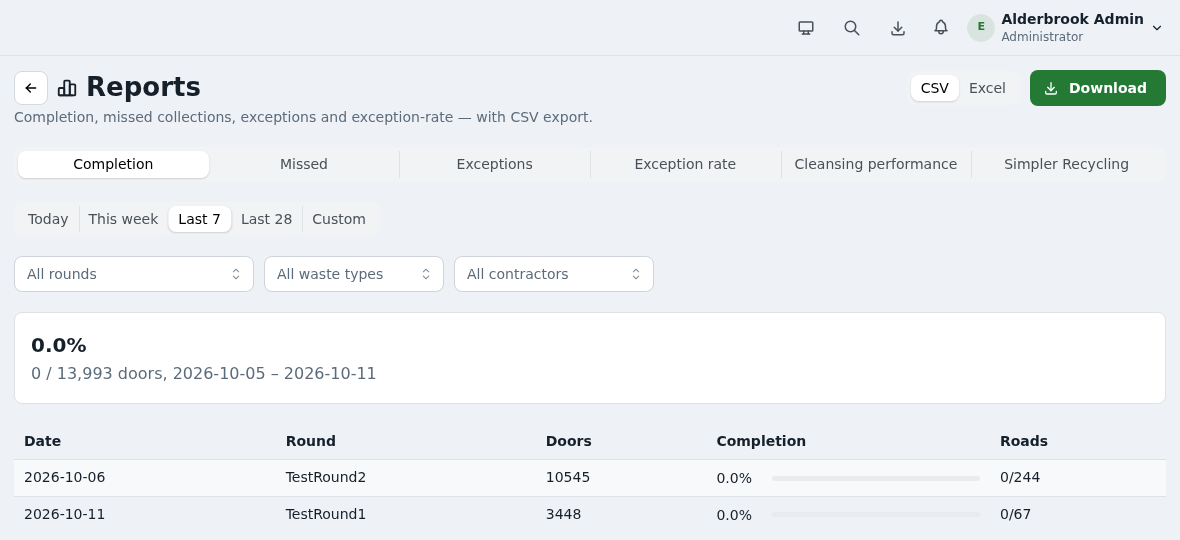
Build or auto-generate rounds and schedules, manage exceptions and missed collections, and pull completion, missed-by-reason, and exception reporting over any date range — exportable, with webhook integration for a council's own CRM or BI tooling.
A full day's work loads once at shift start and runs with zero signal all day — logging every door, photo, and exception the instant it happens, syncing automatically the moment a connection reappears, with an offline map showing hazard and access overlays.
No "submit round" button anywhere — there's no batch to submit. Every log writes to the device immediately and queues safely until signal returns.
Residents look up their bin day, report a missed collection in seconds, and optionally save an address to an account. A separate council customer-service view checks a property's status directly — without ever seeing internal contractor-only detail.
A duplicate-report guard means the same missed bin never generates three separate work orders from three separate callers.
Signed outbound webhooks let a council's own CRM or BI tooling subscribe directly to the event stream as it happens, plus a self-service connector for a council's own citizen-facing form to lodge reports straight into WasteOps.
A modern REST/JSON API throughout — not a legacy integration surface every downstream system has to build a bespoke adapter around.
The fourth product: a configurable tick-box walkaround check with required photo angles, for any commercial fleet operator's legal walkaround obligation — not exclusive to WasteOps customers.
A separate add-on, priced competitively. See the product vision for where things stand.
Who runs the round, and who runs the platform, don't have to be the same question — WasteOps doesn't assume a single fixed relationship between a council and a contractor.
One contractor can run WasteOps across several separate council contracts from a single account, with each contract's data kept separate and enforced at the database layer, not just by application code remembering to filter correctly.
A council running several contractors side-by-side — across zones, streams, or a re-tender in progress — can have each one working the same platform with its own separate, isolated view.
A council collecting in-house, with no third-party contractor in the loop at all, can run WasteOps directly — the platform doesn't assume a contractor has to exist.
Every action a crew logs is its own permanent, timestamped record — written the instant it happens, offline or not, and never silently overwritten. That's the whole foundation. Recovery, reporting, audit, and the three apps above are all just different views onto that same record.
A dedicated, ongoing programme — not an afterthought.
The platform is architected to meet Cyber Essentials, Cyber Essentials Plus, and ISO 27001 — formal certification and an independent penetration test are the planned next step, not yet completed.
WasteOps is in active development. Tell us a bit about your contract and we'll walk you through what's available now, what's next, and what a pilot could look like.
Curious what's next? Read our product vision →